A personal blog of Renzie Baluyut | Cryptids & Cryptozoology | Close Encounters | Extra Terrestrial Activity | Folklore | Forteana | Ghosts & Hauntings | Mysterious Creatures | Mythology | Parapsychology | Paranormal Phenomena | Strange Sightings | The Occult | The Paranormal | The Unexplained | Ufology | Urban Legends | Weird Stuff | Witchcraft | a blog by Renan Salvador Viloria Baluyut

Showing posts with label Mysterious Creatures. Show all posts

Thursday, April 17, 2008

The Phenomenon of The Rat King

In this edition of The Cryptid Files, we deal with the phenomenon known as the Rat King. In medieval Europe, the sighting of a Rat King is an omen that something terrible is about to happen. Read on..

It's a no-brainer, really. Whenever you see a whole bunch of rats tangled up together by the tail- it doesn't take a Nostradamus to divine that something bad might happen. You wanna hear something bad? You probably have TOO MANY RATS!

The Rat King is a cryptozoological phenomena that happens when a number of rats are intertwined at the tails- which are stuck together by a gunk made of blood, filth and excrement. Supposedly, the rats all grow together while joined at the tail- and is seen as an omen of ill fortune, particularly in Germany, where the majority of Rat King sightings and incidents have been reported.

The Mauritianum scientific museum in the town of Altenburg in Thurinia, Germany has a display of the largest well-known rat king (above; picture from Wikipedia). It was said to have been found in a miller's fireplace in 1828, and consists of some 32 rats joined together at the tail.

Theoretically, it is possible to have a rat king- assuming there are thousands of rats living in a tightly cramped space. Some of the young rodents just might find their tails inextricably tied together.

With a population of rats under these living conditions comes the increased chance of outbreak and disease- and so the sighting of a rat king in medieval Europe means a plague is about to hit- so no surprise there.

Rat King Sightings

The earliest reported rat king sighting was in 1564. In modern times, however, these incidents are few and far between- most of which were already exposed as hoaxes.
  • Bogor, Java. A rat king of ten field mice was found in 1918.
  • New Zealand. A rat king discovered in 1930 is displayed in the Otago Museum in Dunedin. It was later found out that the rodents' tails were entangled in a mat of horse hair.
  • In 1963, a rat king was discovered by a farmer in the Netherlands. Further investigation using X-rays show that the rats are joined by their fractured tails tangled together, which according to proponents, show that the creatures survived this way for a rather extended period of time.
  • The most recent sighting of a rat king was in January 2005, discovered by an Estonian farmer in the region of Võrumaa.
Normal Paranormal just brought you another edition of The Cryptid Files: Rediscovering our Strange World one Freak of Nature at a Time.


Wednesday, April 16, 2008

The Popobawa: Spiritual Sexual Predator?

In this edition of The Cryptid Files, we deal with a strange spirit of Zanzibar that roams the night, looking for houses to invade, and victims to sodomize! Read on..

The Unfortunate Tale of Mjaka Hamad

A man from Zanzibar tearfully relates his ordeal to the media- Mjaka Hamad, a peasant farmer in his mid-50's, claims he's been brutally sodomized by the infamous Popobawa. This particular attack in 1995 caused widespread panic among the local residents of these islands, just off the coast of Tanzania in Africa.

Was our farmer making it all up? Maybe a nightmare, even? According to Hamad, he knew it was not a dream because when he woke from his sleep, the household was in uproar.
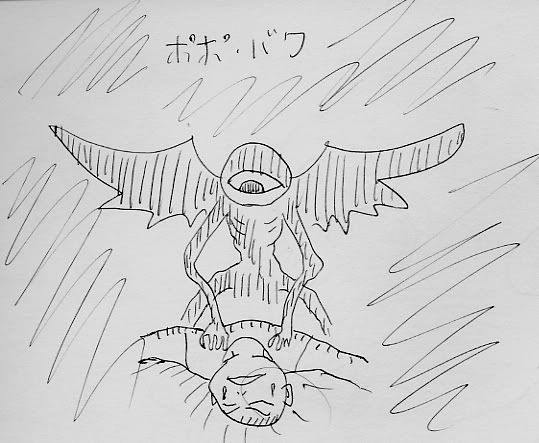
According to About.com's Paranormal Phenomena, this is what Hamad had to relate about his harrowing experience:
I couldn't see it. I could only feel it. But some people in my house could see it. Those who've got the spirits in their heads could see it. Everybody was terrified. They were outside screaming Huyo! It means the Popobawa is there. I had this bad pain in my ribs where it crushed me. I don't believe in spirits so maybe that's why it attacked me. Maybe it will attack anybody who doesn't believe.

Hamad was just one of the victims of the infamous Popobawa. Hospitals in Zanzibar have had dozens of cases attributed to Popobawa-inflicted injuries: mostly broken ribs and bruises. According to X-Project Paranormal Magazine, during times when the Popobawa terrorizes the islands, whole families will often sleep arm-in-arm in front of their houses, seeking safety in numbers.

The Popobawa

The strange creature known as the Popobawa is generally described as a cyclopean dwarf- its one eye centrally located on its large forehead. Reports say the monster also has huge, leathery bat-like wings and ears, sharp claws, and a gigantic penis.
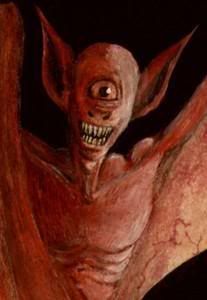
Even stranger is the Popobawa's propensity to anally rape men in their sleep- kind of like a homosexual incubus. The creature attacks its victims as they sleep, overpowering them, forcefully holding their face to the floor and ass-raping them for up to an hour.

And to literally add insult to injury, after it sodomizes its victim, the Popobawa commands the unfortunate male to spread the word of his ordeal, or it would come back for more.

Though often invisible, the creature can be detected by the sound of sharp claws scratching against the victims' rooftops, and an acrid smell or a puff of smoke. In some accounts, such as in the unfortunate case of Mjaka Hamad, the Popobawa is visible to everyone except the terrified victim.

Supposedly, the shapeshifting Popobawa takes human form by day, and blends in among the locals. Only its pointed fingers give a hint to its true identity.

Dealing With the Popobawa

The creature only attacks men, and does so only when its victim is sleeping in his bed. For that reason, many men end up sleeping outside- in streets, on porches- especially after recent waves of Popobawa attacks and sightings.

Those who aren't Muslim have even resorted to smearing pig grease on their skins to keep the demon from latching onto them.

Some have resorted to sacrificing goats, or offering charms by the base of fig trees to help exorcise the Popobawa. Others have even dug around their homes, burying pig bones, to ward off the creature.

What really ticks the monster off is ignoring it: denying the initial experience ever happened supposedly results in repeated, longer and more brutal sodomizations. It seems the hapless victims have no other choice but to tell all their friends and neighbors about the embarrassing incident.

Other Popobawa Facts

The name 'Popobawa' comes from the Swahili words for "bat" and "wing". Some suggest that the original name was 'Pepo Bawa', which means 'winged spirit'.

According to Wikipedia, a popular origin story of Popobawa proposes that in the 1970s an angry sheikh released a djinni to take vengeance on his neighbors. The sheik lost control of the djinni, who took to demonic ways.

Interestingly enough, the Popobawa is a fairly recent cryptid. Reports say that the Popobawa first appeared in 1972, on a neighboring island called Pemba. Waves of sightings and incidents were then reported in the 1980's. And then another wave of attacks came in 1995 (the time of Mjaka Hamad's experience). Then again in 2000-2001, and most recently in Dar Es Salaam in 2007.

Increased Popobawa activity seems to coincide with elections, but its victims would claim that the rise and fall of the electoral cycle has nothing to do with the creature's attacks.

Normal Paranormal just brought you another edition of The Cryptid Files: Rediscovering our Strange World one Freak of Nature at a Time.

Cheers, everyone!

Monday, March 24, 2008

Live Science's 10 Favorite Monsters

Following a story from Cryptozoology.com, I stumbled upon an article on Live Science's 10 Favorite Monsters, which you can check out right here.

Of course, you could read more about them, but to give you all a quick rundown- here they are in descending order:

10. Canada's Ogopogo - does it look like Champ or Nessie?
9. Dragons - interesting how, like ghosts, dragons are mentioned in so many world cultures.
8. The Giant Squid - now that's a LOT of fried calamari!
7. Champ - the monster of Lake Champlain. Read about it on a Readers Digest when I was a kid, I remember.
6. Chupacabra - the goat-sucker of South America.
5. Sirens - they're hot, they sing well, and they'll crush your medieval ships!
4. The Loch Ness Monster of Scotland - plesiosaur, giant snail-like creature, or downright hoax?
3. Werewolves - nasty little beasties!
2. Vampires - these have to be my favorite.
1. Bigfoot. Specifically, the North American sasquatch.

What are your 10 favorite monsters?

The Cryptid Files

Welcome to The Cryptid Files on "Normal Paranormal"!

Even as a child, I had this strange fascination with monsters, strange creatures and mythical beings. There used to be a 'Monsters' section on the old Collier's Encyclopedia which I read over and over again. There's now a term for the study of these creatures, and it's called 'cryptozoology'. It's the zoology of weird things on our planet, and we have a feature right here on this blog.

According to Wikipedia:
In the study of cryptozoology, a cryptid is any animal or creature that has been reported to have existed, but has not been proven to. The literal meaning of the word is "the study of hidden animals". Their presumed existence is often derived from anecdotal evidence and/or other evidence insufficient to prove their existence with scientific certainty.

Cryptids are also uncommonly known by the term Unidentified Mysterious Animals or UMA, an intended variation on the popular term UFO. The English use of the term was coined by John E. Wall in 1983 and has been used ever since to describe the creatures which are the focus of cryptozoology.

The term 'cryptid' may include creatures such as the Yeti, Thunderbird or Loch Ness Monster, or relict animals (once presumed extinct) such as the coelacanth (to the right, from a picture on National Geographic). The term is also used to describe now confirmed animals such as the okapi (the deer-like mammal pictured below), once thought to be a fictional animal until it was discovered in the early 1900s.

Cryptids have existed for many ages, although earlier cryptids such as the griffin or dragon, are by and large considered mythical creatures which have never existed other than in popular fiction. Early cryptids include creatures such as the Kraken, which have now entered into legend as fictitious entities or have since been debunked and attributed to exaggerated sightings of creatures unknown in earlier times. Other cryptids include those which were known to man, but have since been pronounced extinct, as was the case with the moa and thylacine which are both reported to be living today. Despite the large number of reported cryptids, most are never proven and a large portion are debunked through thorough scientific investigation.

Of course, there are a whole lot of cryptids now, when I thought there were only several. Apparently, the list has grown to include a wide variety of creatures, whether from local folklore (like the Chupacabra of South America or the Leeds Devil of New Jersey), urban legend, or even old creatures from the past (like The Congo's Mokele-Mbembe, or The Beast of Busco in Indiana). Check out the entire list- at least one compiled so far- by Wikipedia.

From the Philippines, we have the aswang, manananggal and the tikbalang. I think there should be a kapre on that list as well, though they may have classified that one under 'sasquatch', 'giant' or 'malevolent tree spirit' under the 'Legendary Creatures' category.

In any case, it's always an interesting read, and something I'd like to get back to every so often. Hopefully we find a good story worth sharing to other people online, which is really what The Cryptid Files is all about.

Cheers, everyone.